 blog
blog
Best Commercial Master Key Systems: 2026 Guide
Table of Contents
- What Is a Commercial Master Key System?
- How Commercial Master Key Systems Work
- Master Key System Design Best Practices
- Grandmaster vs. Great Grandmaster Keys: Understanding the Difference
- High-Security Keyway Benefits for Commercial Doors
- Commercial Lock Rekeying Services and Key Management
- Security Considerations and Risk Management
- Choosing the Right System for Your Facility
- Frequently Asked Questions
Last Updated: September 23, 2026
What Is a Commercial Master Key System?
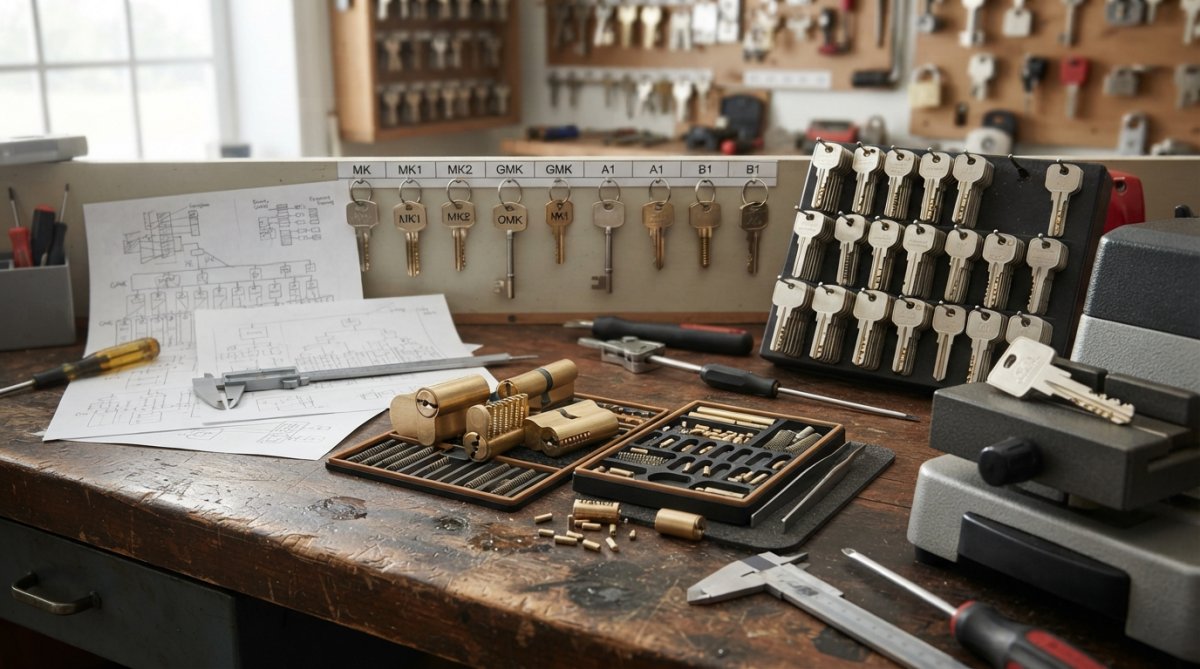
A commercial master key system is a hierarchical locking arrangement that allows one key to open multiple locks while maintaining individual access control for different areas. Instead of managing dozens of separate keys, facility managers use a single master key that operates all locks, while individual change keys work only on specific doors.
This approach balances convenience with security: building managers get quick access to every space while tenants maintain privacy within their units.
The structure works through engineered pins inside each lock cylinder. The master key's cuts align all pins to the shear line, while a change key opens only that specific lock.
The best systems balance three competing needs: speed of access, security integrity, and key control discipline.
How Commercial Master Key Systems Work
The mechanics of commercial master key systems rely on a deceptively simple principle: multiple keys can open the same lock if their cuts align the pins differently.
Pin Tumbler Mechanics and Bitting
Every pin tumbler lock contains five or six pins stacked inside a cylinder. When you insert a key, its cuts push these pins to precise heights. When all pins align at the shear line (the boundary between the cylinder and housing), the lock turns.
A master key system introduces a master pin between the driver and key pin, allowing two different keys to open the same lock.
When the change key enters, it aligns the key pin and master pin at the shear line. When the master key enters, it aligns only the master pin, allowing the cylinder to turn regardless of key pin position.
The bitting (pattern of cuts on the key) must be calculated precisely during system design. A locksmith creates a keying chart that maps which keys open which locks.
Access Hierarchy and Authorization Levels
Commercial master key systems create a pyramid of access: grandmaster keys open every lock, master keys open specific zones, and change keys open individual doors.
This hierarchy enforces accountability. If a change key is lost, only one door is compromised. If a master key is lost, only that zone is vulnerable. The grandmaster key stays locked in a safe.
Some facilities add great grandmaster keys, which open every lock across multiple buildings. A hospital system might use a great grandmaster key for administrator access while maintaining separate grandmaster keys for each building.
Master Key System Design Best Practices
Designing a commercial master key system requires planning before any locks are installed. Start with a detailed facility map and access policy.
First, identify your zones, logical groupings of doors that the same person needs to access. In an office building, zones might be common areas, individual suites, server rooms, and executive offices. Each zone gets its own master key.
Second, determine who needs what access: building managers need grandmaster access, department heads need master keys for their zones, and employees need change keys for their workspace. Document and enforce this policy.
Third, choose your keyway, the shape of the hole that accepts the key. Restricted keyways (proprietary shapes only your locksmith can cut) prevent unauthorized duplication. Standard keyways allow any locksmith to cut keys, creating security risk.
Fourth, plan for growth. If you expect to expand in five years, your initial system must accommodate that expansion without complete rekeying.

Grandmaster vs. Great Grandmaster Keys: Understanding the Difference
A grandmaster key opens every lock in a single system. This key should be stored in a safe and accessed only by the facility manager or during emergencies.
A great grandmaster key opens every lock across multiple independent master key systems. This applies to large organizations with multiple buildings and requires more complex engineering.
The practical difference: a grandmaster key is sufficient for most commercial properties. A great grandmaster key is necessary only when you have multiple buildings with separate systems that need unified access. If you're managing a single office building, you need a grandmaster key. If you're managing a hospital campus with five buildings, each with its own system, you might want a great grandmaster key for the administrator who oversees all five.
The security implication is significant. A great grandmaster key represents the highest level of access across your entire organization. Its loss is a critical security event. Most facilities restrict great grandmaster access to one or two people and keep it in a vault.
High-Security Keyway Benefits for Commercial Doors
A restricted keyway is the first line of defense against unauthorized key duplication. Standard keyways (like the common 5-pin residential keyway) are available everywhere. Any locksmith can cut keys for them if they have a blank and your keying chart. A restricted keyway is proprietary, meaning only your locksmith can cut keys.
High-security cylinders pair restricted keyways with advanced internal mechanics. They use more pins (six to eight instead of five), smaller tolerances, and sometimes rotating or magnetic elements. These features make picking and bumping the lock exponentially harder.
The security benefit extends beyond the lock itself. When you use a restricted keyway, you control the supply of blanks. An employee cannot walk into a hardware store and duplicate their key without authorization. This gives you real key control, not just the illusion of it.
For commercial doors in high-security areas (server rooms, executive offices, cash handling), a high-security keyway is worth the investment. For standard office doors, a restricted keyway without the advanced mechanics is often sufficient. Contact us for a consultation about your facility's specific needs.
Commercial Lock Rekeying Services and Key Management
Rekeying is the process of changing the pin configuration inside a lock so that old keys no longer work and new keys do. It's cheaper than replacing the entire lock and it's the standard approach when tenants move out, employees are terminated, or keys are lost.
A rekeying appointment typically takes 15-30 minutes per lock, depending on the lock type and the locksmith's experience. The locksmith removes the cylinder, takes out the old pins, inserts new pins in a different configuration, and reinstalls the cylinder. The lock hardware itself doesn't change, only the internal mechanism.
Key Control Policies and Tracking Systems
The strongest master key system fails if you don't control who has keys and where they go. A key control policy is a written set of rules governing key issuance, use, and return.
Your policy should specify: who is authorized to request keys, what documentation is required, how keys are issued, how lost keys are reported, what happens to keys when someone leaves, and how often keys are audited. Without these rules, keys proliferate. Former employees keep copies. Contractors make unauthorized duplicates. Your master key system becomes a liability instead of a security asset.
A key tracking system records which key is issued to which person on which date. Simple systems use a physical logbook. Better systems use a spreadsheet. Best systems use dedicated key management software that tracks issuance, return, and loss. When a key is reported missing, you can immediately identify which locks are compromised.
Preventing Unauthorized Key Duplication
Unauthorized duplication happens when someone with a key takes it to a hardware store or locksmith and asks for a copy. If your keyway is standard, the hardware store will cut it. If your keyway is restricted, they cannot without authorization from you.
This is why restricted keyways matter. They're not just about picking resistance, they're about controlling the supply chain. When only your locksmith can cut keys, you know exactly how many keys exist and who has them.
Some facilities go further and require that all keys be returned before an employee leaves. Others use key cards instead of physical keys for certain areas. Some implement a policy where only the facility manager carries the master key, and other staff request access rather than carrying keys themselves.
The best approach depends on your facility size and sensitivity. A small office might rely on restricted keyways and a logbook.
Security Considerations and Risk Management
A master key system introduces a specific security risk: if the master key is compromised, every lock in the system is compromised. This is why master key security requires discipline.
Choosing the Right System for Your Facility
The right commercial master key system depends on your facility's size, complexity, and security requirements.
Frequently Asked Questions
What is the difference between a master key system and a grand master key system?
A master key opens multiple locks within a facility, while a grand master key (or great grandmaster key) operates an additional level above that. In a grand master system, the grand master key opens all locks, master keys open groups of locks, and change keys open individual locks. This creates a three-tier access hierarchy. Great grandmaster systems add a fourth tier for very large facilities. The difference matters for organizations managing multiple buildings or departments with different access requirements.
What are the most secure keyways for commercial master key systems?
High-security keyways use restricted keyway designs that prevent unauthorized key duplication and limit which blanks can be cut. These keyways typically feature unique bitting patterns, patented designs, and specialized cylinders that resist picking and manipulation. Restricted keyways require registered key blanks available only through authorized locksmiths or the manufacturer. High-security keyway benefits include reduced risk of unauthorized access, better key control, and protection against bump keys and other bypass techniques. Your commercial lock rekeying services provider can recommend systems appropriate for your facility's security level.
Is it legal to own a master key for commercial buildings?
Yes, it is legal to own and operate a master key system in commercial buildings. Business owners, property managers, and facility operators routinely use master key systems for legitimate access management. However, the legality depends on authorization and proper use. You must own or have authority over the property and the locks. Creating or possessing master keys for locks you do not own or have permission to access is illegal. Unauthorized key duplication and access to restricted keyways without permission violates locksmith regulations in most states.
How much does it cost to install a commercial master key system?
Installation costs depend on the number of locks, facility size, keyway complexity, and whether you are retrofitting existing locks or installing new hardware. Pricing varies based on whether you choose standard or high-security cylinders, restricted keyways, and additional features like key tracking software. Contact American Locksmith CT for a detailed quote tailored to your facility's specific needs and security requirements.